
Clear, compassionate assessment and practical guidance
Tabla Psychology provides comprehensive Educational Psychology assessments for children and young people in Hampshire and surrounding areas. We help families and schools develop a clearer understanding of a child’s strengths, learning profile and individual needs, including their cognitive, emotional, communication, sensory and developmental needs.
Families may seek an assessment when a child is finding school difficult, making less progress than expected, experiencing challenges with emotional wellbeing or facing barriers to participating fully in school life. There may also be questions about SEND support, appropriate provision or the Education, Health and Care Plan (EHCP) process.
By bringing together information from parents or carers, school, assessment activities, questionnaires and the child’s own views, where appropriate, we build a rounded picture of what may be affecting their learning and wellbeing. This helps us identify helpful support and provide clear, evidence-informed recommendations for home, school and SEND planning.
Our aim is to help your child feel understood and included, while giving the adults around them greater clarity and confidence about the support they may need.
Who is this assessment for?
An Educational Psychology assessment may be helpful if your child is experiencing difficulties with:
- Learning, progress or attainment
- Attention, focus or executive functioning
- Working memory or processing speed
- Emotional regulation or wellbeing
- Communication and interaction
- Sensory processing or regulation
- Developmental co-ordination or physical access to learning
- Confidence, motivation or engagement in school
- School distress or barriers to accessing education
Families also come to us when they are trying to understand whether further assessment, school support, SEND planning or EHCP-related processes may be appropriate.
Where a different or additional assessment may be more suitable, we will guide you as clearly as possible.
How can an Educational Psychology assessment support the EHCP process?
Educational Psychology assessment evidence can help families and schools understand a child’s special educational needs and the provision that may support them.
Our assessments consider the broad areas commonly reflected within Education, Health and Care Plans:
- Cognition and Learning
- Communication and Interaction
- Social, Emotional and Mental Health
- Sensory and Physical needs
Reports can contribute to SEND planning, school support, annual reviews and, where relevant, Education, Health and Care Needs Assessment processes.
An assessment does not guarantee that an EHCP will be issued, amended or agreed by a local authority. However, it can provide clear, independent psychological evidence to support understanding, planning and decision-making.
Please note: this Educational Psychology assessment is not designed for SEND Tribunal proceedings. If you require independent Educational Psychology evidence for Tribunal, please see our separate Tribunal Specific Service, which has limited availability and follows a different assessment and reporting process.
Why families choose Tabla for an Educational Psychology assessment
Families across Hampshire and beyond choose Tabla because our assessments are carried out by HCPC-registered psychologists who combine strong professional and ethical standards with a warm, child-friendly approach.
Our Educational Psychology assessments offer:
- A rounded view of your child’s development, learning and functioning
- Comprehensive information gathering from parents/carers and, where appropriate, school
- Parent and school screeners and questionnaires to understand your child across different settings
- Opportunities to gather your child’s voice, where appropriate
- Consideration of all relevant EHCP areas, including cognition, communication, social and emotional wellbeing, and sensory and physical needs
- Use of psychometric and standardised cognitive assessment tools, where appropriate
- Child-led, relaxed appointment in our clinic designed to help children feel comfortable and settled
- Reports that are detailed, clearly written and designed to support families, schools and SEND planning
- Practical, tailored recommendations and a suggested support plan
- An approach that considers your child’s strengths as well as their areas of need
- Integrated educational and psychological insight to help make sense of your child’s profile
Our approach is neuroaffirming and strengths-based. We do not see children’s differences as problems to be “fixed”. Instead, we aim to understand each child’s profile, the environments they are learning in, the barriers they may be experiencing and the support that may help them feel safe, understood and able to access learning.
A child-friendly space designed for comfort
Our clinic is based at The Old Dairy in Hambledon, near Portsmouth and Petersfield. The space has been designed to feel warm, calm and welcoming.
Freddie, our friendly service dog, is also available to help children feel at ease. Please let us know if you would like him to be part of your child’s visit, or if you would prefer an appointment without him.
What does the assessment involve?
Our Educational Psychology assessment is designed to build a rounded understanding of your child’s strengths, needs, development, learning and day-to-day functioning.
Before the clinic appointment, we send detailed questionnaires and screening measures to parents or carers and, where appropriate and with consent, your child’s school. We may also review previous professional reports, school documents and relevant developmental information.
This helps us understand how your child presents across different settings and may provide information about their:
- Learning and cognitive profile
- Communication and social interaction
- Attention and executive functioning
- Emotional wellbeing
- Sensory processing and regulation
- Developmental coordination
- Engagement with and access to education
We then meet your child at our clinic. The appointment usually lasts around 50 minutes and is child-led and relaxed. Activities are adapted to help your child feel settled and able to engage in a way that works for them.
Depending on the reason for the assessment, the session may include games, activities, discussion and structured or semi-structured tasks exploring areas such as:
- Cognitive abilities and approaches to learning
- Working memory and processing speed
- Executive functioning, attention and concentration
- Communication and interaction
- Developmental coordination
- Sensory and emotional regulation
- Play, learning and problem-solving
- Your child’s views and experiences
Psychometric and standardised cognitive assessment tools are used where appropriate.
Where clinically and educationally appropriate, we may also recommend a separate school observation. This can provide additional insight into how your child experiences their everyday learning environment.
Once the information has been gathered, we bring together the views of parents or carers, school and the child, alongside the assessment findings and any relevant documents. Rather than relying on one test or one source of information, we consider the whole picture.
This integrated approach helps us understand what your child may be finding difficult, why those difficulties may be occurring and what support may help. It also allows us to provide practical, tailored recommendations for home, school and SEND planning.
Working with schools
With parental consent, we gather and consider information from school as part of the assessment process. This may include school questionnaires, information from teaching staff or SENCOs, and relevant school documents where available.
Understanding how your child presents in school helps us consider the relationship between their individual profile, the demands of the learning environment and the support they may need.
As mentioned above, we may recommend an In‑School Observation as an additional part of the assessment process. This can be particularly helpful where there are questions about attention, learning behaviours, social communication, regulation, peer interaction, school distress, classroom access or how your child manages the demands of the school environment.
An in‑school observation allows us to see how your child experiences learning in context and helps ensure recommendations are practical, relevant and tailored to their everyday school life. Observations are usually carried out by Nikki Hammal, SEND Specialist, and can be booked as a separate service. They are subject to availability, travel and scheduling.
Our reports are written to be clear and useful for families, SENCOs, teachers and other professionals involved in supporting the child.
Specific learning difficulties
We also offer diagnostic services for specific learning difficulties, such as dyslexia and dyscalculia.
These are separate assessments and are priced as an additional cost to the Educational Psychology assessment. Please get in touch to find out more.
What happens after the assessment?
Once the assessment is complete, we bring together the information gathered from parents/carers, school, the clinic-based assessment and the child’s own views, where appropriate.
We then prepare a detailed written report. Reports are usually sent within two to four weeks of the assessment appointment.
Your report will include:
- A summary of the reason for assessment
- Relevant background and contextual information
- A clear account of the information gathered from parents/carers, school and assessment
- A full analysis of the areas of development and learning considered
- An integrated understanding of your child’s strengths and areas of need
- Consideration of how identified needs may be affecting wellbeing, learning, participation or attainment
- SMART outcomes for progression
- Comprehensive, specific and measurable guidance and recommended provision
- Practical recommendations for home and school
- A suggested support plan to help integrate findings into everyday life
- Signposting to further assessment or support, where appropriate
The aim is to provide a report that feels clear, useful and meaningful, helping families and schools understand your child’s profile and consider next steps with greater confidence.
Combining assessments
If you are interested in combining this assessment with an Autism or ADHD assessment, please contact us.
We are experienced in combining assessments where appropriate, helping to reduce duplication and build a more joined-up understanding of your child’s needs.
Where a combined approach is not suitable, we will explain this clearly and help you consider the most appropriate route.
Fees
Please get in touch for current pricing.
How this can help
Educational psychology can help you to:
- Understand your child’s cognitive, learning, emotional and communication strengths
- Support educational and community settings with practical support and understanding
- Identify learning strengths, needs and difficulties
- Suggest further support and assessment, as appropriate
- Help your child to understand their own strengths and learning style whilst also improving self-esteem, motivation and attainment
What does it cover?
Assessment areas include:
- Standardised cognitive assessment
- Working memory assessment
- Executive function
- Processing
- Communication and interaction
- Developmental co-ordination
- Sensory regulation
- Attention and focus
- Mental health and Emotional well-being
- Approaches to play and learning/ classroom performance
We also offer diagnostic services for specific learning difficulties (SpLd) such as dyslexia and dyscalculia. These are an additional assessment and are priced as an additional cost to the EP assessment. Please get in touch with us to enquire about these additional services.
What happens during the assessment?
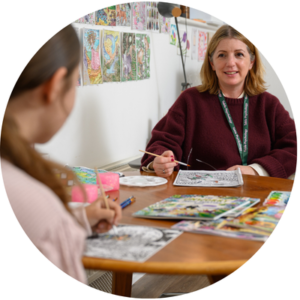
The in clinic appointment for your child lasts 50 minutes. These appointments are always child-led and relaxed in order to ensure that children feel settled in whatever way they need to complete activities and tasks.
You will receive a detailed report and suggested support plan to help integrate the findings and ideas into yours and your child’s life as well as additional support information and guidance on next steps.
Please see our FAQ for more detailed information of our assessment procedure.
Booking and availability
We offer educational psychology assessments for children and teenagers at our Hampshire clinic. If you’d like to book an assessment or simply have a chat about whether it’s the right option for your child, click the link below. Our friendly team is always happy to answer any questions and help you find the best next step.
Educational Psychology Assessment FAQ
Can this assessment support an EHCP application?
Yes. Educational Psychology assessment evidence can support SEND planning and may contribute to an Education, Health and Care Needs Assessment or EHCP-related process.
It does not guarantee a particular local authority decision, but it can provide clear, independent psychological evidence to support understanding, planning and decision-making.
Can this report be used for Tribunal?
EP appointments are always child-led and relaxed in order to ensure that children feel settled in whatever way they need to complete activities and tasks.
No. This Educational Psychology assessment is not designed for SEND Tribunal proceedings.
If you need independent Educational Psychology evidence for SEND Tribunal, please see our separate Tribunal Specific Service. This has limited availability and follows a different assessment and reporting process.
Will my child receive a diagnosis?
An Educational Psychology assessment helps build a profile of your child’s learning, development, strengths and needs. It is not the same as an Autism, ADHD or specific learning difficulty diagnostic assessment.
However, the assessment may indicate whether further assessment could be helpful.
Does the assessment follow HCPC and BPS guidelines?
Our assessments are conducted within both HCPC standards of conduct, performance and ethics as well as the BPS Code of Ethics and Conduct.
What if I am interested in several of your services?
If you are interested in combining this assessment with any of our assessments, please let us know.
What we cannot help with
As we are not a crisis service, we are unfortunately unable to offer assessment of mental illnesses including bipolar disorder, psychosis, an established eating disorder or in cases where there is extensive self-harm or suicidal ideation.
Who should I speak to in case of an emergency?
We are not a mental health crisis service so if you have immediate concerns about your child or young person’s wellbeing, please contact the emergency services or your local NHS Child and Adolescent Mental Health Service crisis telephone line.
Other useful organisations include:
Childline: 0800 1111
Samaritans: 116 123 or text “Shout” to 85258.
What if I want to apply for an Education, Health and Care Plan?
Our reports can support the EHCP process. Please see here for more information on your legal rights to apply.
Do you liaise with school?
Where appropriate and with consent, we gather information from school as part of the assessment process. This may include school questionnaires, information from staff and relevant school documents.
This helps us understand how your child presents in their learning environment and ensures recommendations are practical and relevant.
Do you observe children in school?
Where clinically and educationally appropriate, we may recommend an in-school observation as an additional part of the assessment process.
This can be particularly useful when a child’s needs are most evident in school, or where it would be helpful to understand attention, learning behaviours, social communication, regulation, peer interaction, school distress, classroom access or the demands of the school environment
How long does the report take?
Reports are usually sent within two to four weeks of the assessment appointment.
What if my child finds appointments difficult?
Appointments are child-led and relaxed. We adapt the session as much as possible to help children feel comfortable, settled and able to engage in a way that works for them.
We understand that some children need time, flexibility and reassurance. Our aim is to create an assessment experience that feels as calm and supportive as possible.
What if we are not sure which assessment we need?
Please get in touch and we can help you think through the most appropriate next step.
Some children may benefit from an Educational Psychology assessment, while others may need an Autism assessment, ADHD assessment, specific learning difficulty assessment, school observation or another form of consultation. Where a different route may be more suitable, we will guide you as clearly as possible.

